Considering a career in Insolvency: What to consider – *Guest Post*

For our latest blog, we have a guest post from Chris Bristow at Real Business Rescue.


Insolvency represents an exciting and rewarding career which sits as much within the finance arena as it does within law. Insolvency professionals will either work for an independent insolvency firm, or as part of a firm of lawyers or accountants.

In a nutshell, a career in insolvency involves working with financially distressed businesses or individuals who require professional intervention to deal with their financial woes. Many insolvency firms will offer both personal and corporate insolvency advice, although many insolvency professionals will choose to specialise in one or the other.

  • Corporate Insolvency – Corporate insolvency involves dealing with distressed limited companies and their shareholders/directors. Depending on the financial position of the company coupled with its long-term viability, options may include a restructuring of the company’s operations through a process of administration, or entering into formal negotiations with creditors by way of a Company Voluntary Arrangement (CVA). If the company’s problems have taken it beyond the point of rescue, there may no alternative other than to close the company down by placing it into liquidation.
  • Personal Insolvency – When working in personal insolvency, you will be helping individuals understand their options for dealing with unmanageable debt which may include Individual Voluntary Arrangements (IVAs) and Bankruptcy. Other options are available to individuals in Scotland.

Roles within insolvency

A career in insolvency offers a huge amount of growth and further career opportunities if an individual is prepared to work hard. While each firm will structure their insolvency department in their own way, typical roles on offer will include:

  • Insolvency Administrator – This is how many insolvency professionals careers start. While some individuals will enter the industry with a background in accountancy or law, there are no specific entry requirements or qualifications needed, instead you will learn ‘on the job’. A typical days’ work will involve filing statutory notices at Companies House and liaising with creditors including HMRC.
  • Insolvency Manager – With several years’ experience under your belt as an Insolvency Administrator, you can move up the career ladder to a management position. As an insolvency manager you will be expected to manage your own caseload and work closely with the appointed insolvency practitioner; you are likely to have a team of insolvency administrators working underneath you who you will line manage. You may also find yourself taking the initial phone call from a distressed director, providing help and advice and talking through the available options. At this stage in your insolvency career you may wish to solidify your knowledge by sitting the Certificate of Proficiency in Insolvency (CPI) exam, an industry recognised qualification that demonstrates your technical and practical knowledge of the sector.
  • Licensed Insolvency Practitioner – In order to become a licensed insolvency practitioner you will need to successfully pass a series of gruelling exams known as the JIEB (Joint Insolvency Examination Board). There is one exam for personal insolvency and another one for corporate insolvency. Insolvency practitioners can hold a full license (upon passing both exams) or alternatively a partial license in either personal insolvency or corporate insolvency if just one of the exams has been passed.


In addition to the JIEB, aspiring insolvency practitioners must also record a minimum of 600 hours of higher experience in insolvency administration within the preceding 5 years as well as registering with one of the five recognised RPBs in order to obtain their licence. Once licensed, an insolvency practitioner will then be legally allowed to take insolvency appointments according to their license, from company liquidations and personal bankruptcies, through to administrations and Company Voluntary Arrangements (CVAs).

Skills you will need

In addition to the formal qualifications required to become a licensed insolvency practitioner, highly developed soft skills in areas such as empathy and the ability to explain complex legal procedures in simple, understandable terms, are also coveted within the industry.

You will be required to liaise with a number of parties as part of any insolvency case, including directors/shareholders, outstanding creditors, HMRC, and any employees of the business. In many cases you will be delivering news which is unwelcome, such as notifying employees of redundancy, or explaining to creditors that they will not receive the money back they are owed. You must therefore have the communication skills required to deal with these potentially uncomfortable conversations and ensure each party understands how they will be affected by the insolvency.

In addition, insolvency legislation is ever-changing, therefore a commitment to ongoing training and development to ensure skills and knowledge are kept up to date is a must.

Considering a career in insolvency? Here’s why you should!

  • Variety – As insolvency sits between the law and finance, you will find that your workload remains interesting and varied. One day you could be completing accountancy based tasks such as preparing a Statement of Affairs, while the next you are building up evidence to support a case against a director for wrongful or fraudulent trading.
  • Rewarding – While there may be some negative connotations towards the insolvency industry from those who do not fully understand how it works, the reality is that formal insolvency solutions offer companies or individuals a way out of a situation which has become simply unmanageable. Helping a distressed individual understand their options and working alongside them to put a plan in place can be an extremely rewarding part of the job.
  • Security – Insolvency is a counter-cyclical industry which means demand for the service is likely to increase the worse the economy gets. This is in contrast to many other occupations where a thriving economy comes with increased demand. This can provide a reassuring element of job security in otherwise challenging times.


About the author – Chris Bristow is a business debt expert at Real Business Rescue, company rescue, restructuring and liquidation specialists with a wealth of experience in supporting company directors in financial difficulty.

The Double-Edged Sword of Remote Working

We have seen an increase in requests from candidates for remote working opportunities, however, we are seeing the opposite for the majority of our clients, who are requesting staff are office-based more than home.

The shift towards remote working, driven largely by the global pandemic, undoubtedly changed the landscape of many professions, including those in the insolvency and accountancy practice sectors. Firms worldwide embraced this change, with many employees relishing the chance to work in their home environment, away from the daily commute and office politics. However, while the advantages of remote work are plenty and often discussed, it’s crucial to shed light on potential pitfalls, particularly regarding personal development and progression.

The Positives: The Bright Side of Remote Work

Before delving into the challenges, it’s only fair to highlight some of the significant benefits of remote working:

  • Flexibility: Working from home often offers flexibility in hours, allowing employees to strike a more harmonious work-life balance.
  • Reduced Commute: No more rush-hour traffic or packed trains, which saves time and reduces daily stress.
  • Cost Savings: Employees save on daily expenses such as travel, meals, and professional attire.
  • Increased Productivity: Many find that they can concentrate better at home, leading to increased productivity and efficiency.

The Flip Side: Potential Barriers to Development and Progression

However, remote working is not without its challenges, especially when considering the nuances of roles within insolvency and accountancy. See also our post on The Power of Internal Networking.

  • Reduced Face-to-Face Interactions: There’s something about in-person communication that virtual platforms can’t replicate. For roles in accountancy and insolvency, where networking and relationship-building are paramount, the lack of face-to-face interactions can be detrimental. It’s through these interactions that many opportunities arise, be it new client work, cross-departmental projects, or even promotions.
  • Learning On The Job: Particularly for those in the early stages of their career, being physically present in the office offers a chance to learn by observation. Witnessing how senior practitioners handle complex situations, or simply absorbing the office dynamics, is harder to achieve remotely.
  • Visibility and Recognition: Out of sight can, unfortunately, mean out of mind. Those working remotely might find it harder to showcase their achievements or be recognized for their efforts, which could impact promotional opportunities. Read another of our posts, Finding The Right Balance: Office Visibility And Career Progression.
  • Feedback Loop Delays: Instant feedback is invaluable. In an office, a senior can quickly guide or correct a junior colleague. In a remote setting, these feedback loops might be extended, which could slow down the learning process.
  • Isolation and Well-being: Feeling isolated can have a significant impact on an employee’s well-being, potentially affecting job satisfaction, performance, and overall career progression. While firms in insolvency and accountancy practice are known for their tight-knit communities, working remotely might make it challenging for some to feel connected.

Navigating Remote Work Successfully

While the challenges are real, they aren’t insurmountable. Here are some ways to ensure you continue to progress in your career, even when working remotely:

  • Regular Check-ins: Schedule regular one-on-ones with your seniors and team. This not only ensures you’re on the right track but also keeps you visible.
  • Networking: Just because it’s remote work doesn’t mean networking should stop. Attend virtual events, webinars, and training specific to insolvency and accountancy practice to stay connected.
  • Seek Feedback: If you feel you aren’t getting enough feedback, ask for it. Regularly touch base with your mentors or colleagues for insights into your performance.
  • Continuous Learning: Make use of online courses and resources. In the rapidly evolving fields of insolvency and accountancy, staying updated is crucial.

In Conclusion

Remote working, while offering numerous benefits, does come with challenges, especially concerning career progression. But by being proactive, seeking feedback, and staying connected, those in insolvency and accountancy practices can continue to grow, develop, and achieve their career aspirations, irrespective of where they’re working.


My views are based on my 17 years+ of recruiting for Insolvency and Accountancy Practice professionals.

For advice about your career options, Insolvency Jobs, Audit Jobs or Tax Jobs, speak to Scott Lowes (slowes@levitaterecruitment.com) at Levitate Recruitment, specialists in placing insolvency professionals and practice-trained accountants across the UK, and find the right role to suit your ambitions.

 

Asking The “Reservation Question” in Interviews

An interview process is a two-way street. Not only is the interviewer evaluating the candidate, but the candidate is also assessing the company and the role. While many candidates are prepared with a list of questions to ask at the end of an interview, there’s one question that every candidate should ask the interviewer: “Do you have any reservations about my suitability for this opportunity?

Let’s explore why this question is turning heads and how candidates can wield it effectively.

Why The “Reservation Question” is Significant 

  • Demonstrates Confidence: By directly addressing potential doubts or gaps in one’s profile, candidates show a level of self-assuredness. They’re not shying away from their weaknesses but are instead keen to address them head-on.
  • Puts the Interviewer in a Reflective Position: This question requires the interviewer to critically evaluate the interview while it’s still fresh, allowing candidates to gauge the interviewer’s initial reactions.
  • Offers Instant Feedback: Instead of waiting anxiously for feedback after the interview, candidates get a real-time insight into how the interview went, and where they might stand.
  • Opportunity for Immediate Clarification: If there’s a particular aspect the interviewer is uncertain about, the candidate gets the chance to clarify or provide additional details then and there.

Benefits for the Candidate

  • Addressing Misunderstandings: Perhaps the interviewer misunderstood a particular point or missed a detail on the candidate’s resume. This question gives candidates a platform to rectify that.
  • Highlighting Adaptability: Even if there’s a genuine skill gap, candidates can explain their learning agility, past experiences where they’ve quickly acquired new skills, or their strategy to bridge the gap swiftly.
  • Reaffirming Interest: By asking this question, candidates signal their strong interest in the role. They’re eager to understand the company’s concerns so they can address them — showing commitment and enthusiasm.

How Interviewers Might Perceive It

While many interviewers appreciate the frankness and confidence this question reflects, others might be caught off-guard. Some could view it as too forward or presumptive. However, the majority would value the candidate’s proactive approach and interest in personal growth.

Tips for Candidates

  • Be Genuinely Open to Feedback: Don’t ask this question if you are not prepared to hear constructive criticism. Embrace feedback with an open mind.
  • Be Prepared to Address Concerns: Think about potential reservations in advance and be ready with concise, effective responses.
  • Maintain a Positive Demeanour: If the interviewer does express reservations, respond gracefully. This is not a challenge but an opportunity to clarify or learn.

Conclusion

The “reservation question” is more than just a query. It’s a strategic move, designed to provide candidates with insight, offer clarification, and demonstrate confidence. For those bold enough to ask it, the rewards — in terms of feedback, opportunities to clarify, and impressions made — can be substantial. As the job market becomes increasingly competitive, standing out positively in the mind of an interviewer can make all the difference, and this question might be the key.

We have a number of other blogs posts that may help with your interview preparation;


My views are based on my 17 years+ of recruiting for Insolvency and Accountancy Practice professionals.

For advice about your career options, Insolvency Jobs, Audit Jobs or Tax Jobs, speak to Scott Lowes (slowes@levitaterecruitment.com) at Levitate Recruitment, specialists in placing insolvency professionals and practice-trained accountants across the UK, and find the right role to suit your ambitions.

The Power of Internal Networking for Insolvency & Accountancy Professionals

In the professional realm, the term ‘networking’ often conjures up images of industry events, B2B groups, or coffee meetings with potential clients or contacts outside one’s organisation.

However, a frequently overlooked, yet invaluable, networking terrain exists right under our noses: our very own workplace. For those in accountancy practices and insolvency specialists, internal networking is particularly crucial. Why? Let’s delve into the importance and benefits of connecting within the firm.

Why Internal Networking?

  • A rounded understanding of the Firm: Interacting with colleagues from different teams or departments provides a comprehensive view of the organisation’s operations. This perspective helps professionals better understand their role within the larger context and equips them to offer more integrated solutions to clients.
  • Mentorship Opportunities: Establishing relationships with seasoned professionals or higher-ups can provide mentorship opportunities, guiding younger professionals through the complexities of the industry.
  • Boosting Team Synergy: When you know your colleagues beyond their job titles, collaboration becomes smoother. It’s easier to approach someone you’ve had a conversation with for insights or assistance.
  • Unlocking Hidden Opportunities: Many opportunities or projects within firms aren’t advertised on official channels. They’re often filled through word of mouth. Networking internally can ensure you’re in the loop for these chances.
  • Personal Development: Engaging with a diverse group of professionals within the firm can expose you to different working styles, strategies, and perspectives. This variety is a rich resource for personal growth and skill enhancement.
  • Job Security and Progression: Building robust internal relationships can be a safeguard during tough times. When you’re known (and valued) by many, it’s less likely you’ll be the first on the chopping block. Moreover, if there are openings in senior roles or different departments, your internal connections can be your advocates.

Benefits of Networking Across Hierarchies

  • Peers: Networking with contemporaries offers peer support. They understand your challenges best, can provide real-time advice, and together, you can brainstorm innovative solutions.
  • Higher-ups: Forming relationships with senior professionals and decision-makers can be particularly beneficial. They can provide insights into the industry’s future trajectory, offer guidance based on their experiences, and may even consider you for high-profile projects or teams they’re leading.

Tips for Effective Internal Networking

  • Attend Company Events: Whether it’s a training session, team-building activity, or an informal get-together, ensure you’re present. These are excellent opportunities to interact and connect.
  • Volunteer for Cross-functional Teams: If there’s a cross-departmental project or committee, volunteer. It’s an excellent way to meet professionals from other areas of the firm.
  • Lunch and Coffee Breaks: Instead of heading out alone or always sitting with the same group, invite a colleague from another department or a senior you respect.
  • Be Genuine: Internal networking shouldn’t be approached with a transactional mindset. Seek genuine connections, be curious, and aim to learn.
  • Stay Updated: Keep yourself informed about the firm’s developments, industry news, and any training or courses that might benefit your role. Being knowledgeable makes you a valuable conversationalist.

Conclusion

Internal networking is a goldmine of opportunities, especially within insolvency and accountancy practices. It not only facilitates better working relationships and team dynamics but also paves the way for professional growth and advancement. As you navigate your career in this specialized industry, remember: sometimes, the most influential connections are just a desk or a floor away. Don’t miss out on them.

We have some additional posts on the benefits of networking;


My views are based on my 17 years+ of recruiting for Insolvency and Accountancy Practice professionals.

For advice about your career options, Insolvency Jobs, Audit Jobs or Tax Jobs, speak to Scott Lowes (slowes@levitaterecruitment.com) at Levitate Recruitment, specialists in placing insolvency professionals and practice-trained accountants across the UK, and find the right role to suit your ambitions.

 

Conquering the Fear of Change: Embracing New Job Opportunities

Change is an inherent part of life. From the changing of seasons to the phases of life, everything around us is in a constant state of flux. Yet, we often find ourselves resistant to change, especially when it comes to major life decisions like switching jobs. The very idea of leaving the familiar behind can ignite feelings of anxiety, uncertainty, and doubt.

Why is change, particularly job change, so daunting? Let’s understand why we feel these fears and identify ways to overcome them.

Understanding the Fear of Change

  • Loss of Comfort: The adage, “better the devil you know” sums up this fear. We grow accustomed to our routines, colleagues, tasks, and even the route we take to work. This familiarity breeds comfort.
  • Fear of Failure: “What if it doesn’t work our?” This nagging doubt can prevent many from seeking new opportunities, fearing they might fail in a different role or company.
  • Uncertainty of the Unknown: Stepping into a new environment, with unfamiliar faces and tasks, can be intimidating. We don’t know what to expect, and that unpredictability can be scary.
  • Perceived Lack of Preparedness: The belief that we’re not adequately equipped for a new role can also deter us from exploring new avenues.

Exploring New Opportunities Doesn’t Mean Committing

It’s vital to remember that exploring doesn’t equate to committing. Job hunting and interviewing offer you a chance to gauge the market, understand your worth, and assess potential growth areas. Here are some reasons why looking at your options are beneficial:

  • Assessing the Market: By diving into the job market, you get a clearer picture of the demand for your skillset, potential salary increases, and other perks you may be missing out on.
  • Building Confidence: Going for interviews and interacting with potential employers can boost your self-esteem. It’s affirming to realize that other companies value your experience and expertise.
  • Gaining Perspective: Exploring opportunities can provide you clarity about what you want from your career – be it growth, work-life balance, a better work culture, or increased remuneration.
  • No Strings Attached: The crucial point to remember is that even if you’re made an offer, there’s no obligation to accept it. Offers are opportunities, not shackles. If none of the new offers feels like the right fit or offers significant advantages over your current role, you can decline and stay where you are until you feel a better opportunity arises..

Tackling the Fear Head-On

  • Information is Power: Before making any decision, arm yourself with knowledge. Research companies, roles, and even reach out to current or past employees for genuine feedback.
  • Visualise Success: Instead of getting bogged down by fear, picture yourself succeeding in the new role. Visualisation can be a potent tool to combat negativity.
  • Acknowledge the Fear: Accept that feeling scared is natural. Instead of suppressing the fear, confront it. Ask yourself, “What’s the worst that could happen?” Often, you’ll realise that the worst-case scenario isn’t as bad as you imagined.
  • Stay Grounded: Remember, you always have a choice. Just because you’ve explored other opportunities doesn’t mean you’re obligated to leave your current job.

Conclusion

Change, while intimidating, can be the gateway to growth. Embracing change, especially in our professional lives, can lead to uncharted territories of success. Remember, the act of exploring new job opportunities is merely an exercise in understanding your worth in the market and realising your potential. It’s a journey of self-awareness and growth, not a binding commitment. So, the next time you find yourself contemplating a job switch, approach it with curiosity and openness, leaving the crippling fear behind.

If you are starting to consider your career options, here are some further blogs that may help;


My views are based on my 17 years+ of recruiting for Insolvency and Accountancy Practice professionals.

For advice about your career options, Insolvency Jobs, Audit Jobs or Tax Jobs, speak to Scott Lowes (slowes@levitaterecruitment.com) at Levitate Recruitment, specialists in placing insolvency professionals and practice-trained accountants across the UK, and find the right role to suit your ambitions.

Winning the Video Interview Game: Key Insights for Employers and Candidates

In the wake of the pandemic, the traditional job hiring landscape underwent a major shift. The time-honoured practice of in-person interviews was increasingly replaced by video interviews, a trend that continues to shape recruitment processes. While face-to-face interviews are making a comeback, the role of video interviews in accelerating the recruitment process cannot be understated, particularly in the context of international hiring.

This blog delves into the benefits and challenges of video interviews for employers and insolvency, audit and tax job seekers, offering practical tips to ace this new normal in recruitment.

Advantages and Pitfalls for Employers

Benefits

  • Cost-Effectiveness: Video interviews eliminate travel, slashing significant recruitment expenditure.
  • Scheduling Flexibility: The absence of travel eases interview timing coordination.
  • Time Conservation: With commute out of the equation, the focus can be solely on the interview.
  • Access to Global Talent: The virtual format enables tapping into international talent, raising the bar for recruitment.

Challenges

  • Technical Hitches: Connectivity issues and poor audio-video quality could potentially disrupt the interview.
  • Missed Non-verbal Cues: The nuances of body language and facial expressions, crucial to interviews, can be hard to read.
  • Potential Distractions: Candidates may find themselves in environments not conducive to focused conversation.
  • Lack of Personal Connection: The virtual format can create barriers to establishing rapport with the candidate.

Pros and Cons for Candidates

Benefits

  • Comfort and Convenience: The familiarity of home reduces stress and enhances comfort during interviews.
  • Broadened Access: Virtual interviews unlock job opportunities beyond geographical constraints.
  • Streamlined Preparation: With resources at their fingertips during the interview, candidates can better equip themselves.
  • Improved Communication: Viewing the interviewer’s reactions in real-time can help candidates tailor their responses.

Challenges

  • Technical Difficulties: Internet issues can cause interruptions, leading to stress and performance impacts.
  • Impersonal Experience: Building a connection with the interviewer can be more challenging in a virtual setting.
  • Potential Distractions: Domestic settings might pose unexpected interruptions.
  • Increased Anxiety: The unfamiliar format may exacerbate nerves for some candidates.

Tips for Excelling in Video Interviews

Preparation is key. Double-check your technology, dress professionally, pick a quiet, distraction-free spot for your interview, and rehearse answers to common questions. Keep the interaction natural, not robotic.

Maintain eye contact, articulate clearly, use natural body language, and actively listen to the interviewer before responding. Use reliable video conferencing platforms like Zoom or Skype, and always have a backup plan in case of technical disruptions. Appropriate lighting and a neutral background keep the focus on you.

Be ready to go at least five minutes early. Even though it is a virtual meeting, remember to dress appropriately. Conclude the interaction by thanking the interviewer for their time.

In conclusion, the advent of video interviews, though catalysed by the pandemic, is a trend that has reshaped the job market. As we navigate this change, recognising its unique challenges and leveraging the advantages, we can turn potential roadblocks into opportunities for growth and connection.

We have a number of other blogs posts that may help with your interview preparation;


My views are based on my 17 years+ of recruiting for Insolvency and Accountancy Practice professionals.

For advice about your career options, Insolvency Jobs, Audit Jobs or Tax Jobs, speak to Scott Lowes (slowes@levitaterecruitment.com) at Levitate Recruitment, specialists in placing insolvency professionals and practice-trained accountants across the UK, and find the right role to suit your ambitions.

 

How Your Social Media Past Can Influence Your Career Future

In the digital age, your online persona can have a significant impact on your professional life when you are looking for Insolvency Jobs, Audit Jobs or Tax Jobs. Just as you wouldn’t walk into an insolvency job interview without brushing your hair or wearing suitable clothes, you shouldn’t neglect your social media presence. From Facebook and Twitter to Instagram and beyond, your online activity leaves a digital footprint that potential employers often explore.

The Lasting Impact of Social Media History

Remember that tweet you posted when you were 15? You might not, but it’s likely still out there, and it could be influencing potential employers’ perceptions of you. As an Insolvency and Accountancy Practice recruiter, I’ve seen first-hand how employers often conduct social media background checks on candidates. Sadly, I’ve experienced situations where at least two candidates (that I know of) were not taken forward to interview due to the results of these checks, highlighting the influence your social media history can have on your career.

Your Past Posts May Not Reflect Your Current Self

People evolve, and what you posted years ago may not reflect who you are today. However, potential employers might not see it that way. High-profile figures, including sports stars and celebrities, have faced public backlash after old tweets resurfaced, illustrating the long-term effects of careless social media use.

I confess I’ve even had moments of cringing when I’ve looked back at my own social media posts from 18 years ago. It’s a stark reminder that our online history can stick around much longer than we’d like.

How to Conduct a Social Media Review

To protect your professional reputation, it’s crucial to conduct regular social media reviews. Here’s how:

Scroll back through your posts: This might be time-consuming, but it’s worth it. Look for any content that could be perceived as offensive, insensitive, or unprofessional.

Consider the context: Remember, the context of your posts might have changed over time. Something you posted years ago might now be considered inappropriate.

Delete or archive old posts: If you come across any concerning content, consider deleting or archiving it. Remember, just because it’s in the past doesn’t mean it won’t affect your future.

Adjust your privacy settings: Ensure that your personal posts are only visible to your friends or trusted connections. Be aware that public posts are accessible to anyone, including potential employers.

Think before you post: As a rule of thumb, if you wouldn’t say it in a job interview, it’s best not to post it online.

In conclusion, your social media history can significantly impact your career. So, just as you would review your CV before a job application, consider reviewing your online presence. After all, you want to put your best digital foot forward. (We have another post on Social Media Etiquette: Building A Professional Presence).


My views are based on my 17 years+ of recruiting for Insolvency and Accountancy Practice professionals.

For advice about your career options, Insolvency Jobs, Audit Jobs or Tax Jobs, speak to Scott Lowes at Levitate Recruitment, specialists in placing insolvency professionals and practice-trained accountants across the UK, and find the right role to suit your ambitions.

 

Don’t judge a book by its cover – are you letting a Job Title hold back your career?

In the insolvency and restructuring job market, professionals often place a significant emphasis on their job titles. As an insolvency recruiter specialising in this sector for over 17 years, I’ve observed how focusing on job titles can create unnecessary barriers to exploring new opportunities or taking on roles that offer substantial professional growth. In this article, we will discuss the importance of looking beyond job titles to achieve career success specifically in the insolvency and restructuring field.

Simple Job Title Hierarchy

A basic job title hierarchy in the insolvency and restructuring market might look like this:

  • Junior/Trainee Administrator
  • Administrator
  • Senior Administrator
  • Assistant Manager
  • Manager
  • Senior Manager
  • Director
  • Partner

While this hierarchy provides a general framework, keep in mind that job titles can vary greatly between companies within the insolvency and restructuring sector, making them difficult to compare.

The Inconsistency of Titles Across the Insolvency and Restructuring Sector

As mentioned earlier, job titles can be inconsistent across different companies. For example, consider the case of assistant manager candidates. In some practices, their role and responsibilities would align more with a senior insolvency administrator, while in others, their duties would be typical of a manager. This inconsistency can lead to confusion and missed opportunities if you’re only looking at the job title when considering new roles.

The Impact of Inflated Titles on Career Progression

Some firms in the insolvency and restructuring market assign inflated titles to their staff, which can be a double-edged sword. For instance, a company may give the title of “assistant manager” to employees whose responsibilities are more in line with a senior insolvency administrator. While this may help retain staff because they might find it difficult to move on and find another role at the same level, it can also create a mental barrier for these individuals, who may be reluctant to take a perceived step down in title, even if the new role offers better opportunities for growth.

At more senior levels, we see a similar situation with titles like senior manager and associate director. I recently assisted several professionals in moving from a manager position at one firm to an associate director role at another. Although their new title and responsibilities were more in line with a traditional senior manager.

Inflated titles can have a detrimental impact on future career development. Potential employers might perceive a candidate as overqualified for roles that could be a perfect fit, simply because their title suggests they have more experience than they actually do.

Focus on What Truly Matters

Instead of solely concentrating on the job title, consider the following factors when evaluating a new career opportunity in the insolvency and restructuring market (also take a look at Making the Right Choice: What to Think About Before Accepting a Job Offer):

Responsibilities: What are the key tasks and duties associated with the role? Will you be challenged and gain new skills and experiences relevant to the insolvency and restructuring field?

Growth Opportunities: Does the position offer the potential for professional development, either within the company or by building a strong foundation for future roles in the insolvency and restructuring sector?

Company Culture: Is the company’s work environment and values aligned with your own? A positive and supportive culture can make a significant difference in your job satisfaction and overall success.

Salary and Benefits: While not the sole focus, it’s essential to ensure the compensation package is fair and meets your financial needs.

Work-Life Balance: Does the role allow for a healthy balance between work and personal life? This aspect is crucial for long-term happiness and well-being.

Go Beyond the Title

When planning your career progression in the insolvency and restructuring market, don’t let job titles limit you. Focus on the responsibilities and opportunities for growth that each role presents. I’ve seen people achieve their desired title and then stagnate because they stopped pushing themselves to keep developing. Regardless of your title, always assess whether your daily tasks contribute to your professional development in the insolvency and restructuring sector.

Stay Flexible and Adaptive

In today’s rapidly changing job market, adaptability is a valuable asset, especially in the insolvency and restructuring field. Being open to new roles, industries, or even locations can help you uncover hidden opportunities and expand your career horizons. Flexibility also allows you to respond more effectively to the evolving demands of the insolvency and restructuring market, keeping your skills and knowledge relevant and up to date.

Embrace a Holistic Approach to Career Growth

Ultimately, achieving success in the insolvency and restructuring market requires a holistic approach to career growth. Look beyond job titles and focus on the skills, experiences, and opportunities that truly matter for your professional development. By doing so, you will unlock your full potential and pave the way for a more fulfilling and rewarding career in this dynamic and evolving field.


My views are based on my 17 years+ of recruiting for Insolvency and Accountancy Practice professionals.

For advice about your career options, Insolvency Jobs, Audit Jobs or Tax Jobs, speak to Scott Lowes at Levitate Recruitment, specialists in placing insolvency professionals and practice-trained accountants across the UK, and find the right role to suit your ambitions.

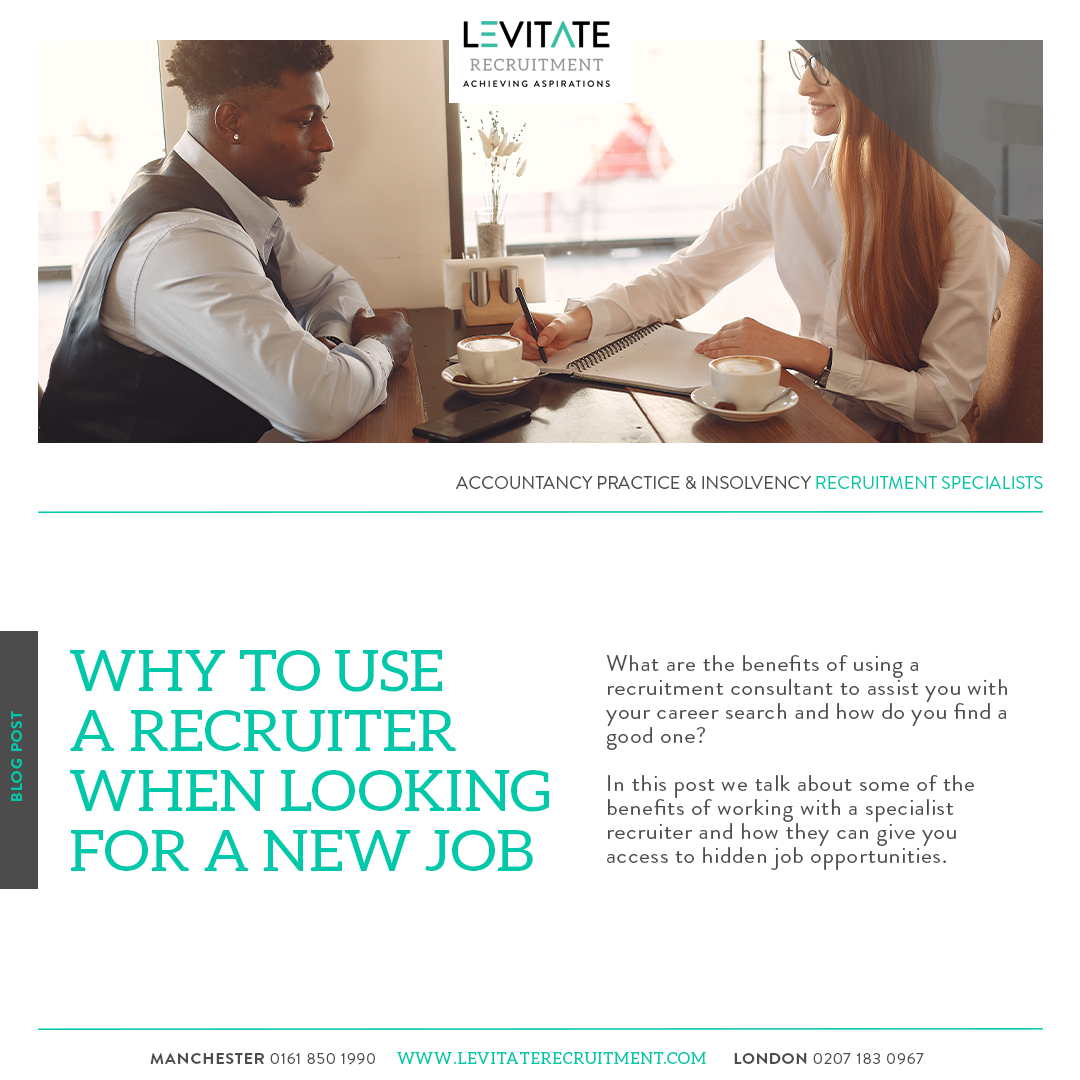
Why to use a recruiter when looking for a new job

What are the benefits of using a recruitment consultant to assist you with your career search and how do you find a good one?

When discussing Insolvency Jobs, Audit Jobs or Tax Jobs, comments I often hear from people I speak with for the first time include; ‘I’ve had a bad experience with recruitment consultants’ or ‘I’ve heard bad things about recruiters. This on occasion can lead to the conversation being cut short by the individual.

We’ve all had or heard of bad experiences when eating out, however, the bad taste it leaves doesn’t stop us from using a restaurant again, we may however decide not to consider that particular establishment! As in life; there is always good and bad, so don’t let the bad stop you from being open to benefiting from working with a recruiter that is very good at what they do and one that can assist you in achieving your aspirations.

How do you know what you could be potentially missing out on until you listen?

Recruitment strategy is very different across each industry sector so it is important to try and gain a good understanding of market drivers. The Insolvency and Accountancy practice job markets are typically candidate-led markets rather than job led. This means that potential opportunities are focussed more on an individual’s experience and if they can add value rather than a specific recruitment need or advertised opportunity. Over the last 12 months, more than 70% of the people we assisted at Levitate Recruitment have found new insolvency job, audit jobs or tax job opportunities with companies that didn’t have a specific job advert posted.

As a specialist Insolvency and Accountancy practice recruiter, I can only offer my views on the benefits of using a recruiter if you are looking for an opportunity in Insolvency and Accountancy Practice. If you are looking for a role in commerce and industry or another sector, some but not all may be applicable.


What are the benefits of using a Recruitment Consultant to assist you with your career search and how do you find a good one?

It’s free!

Using a recruitment consultant is free to the job seeker. Recruitment consultants are paid by companies to find suitable staff for their firm, so they are motivated to assist you in securing the right career opportunity.

A recruitment specialist in your industry

A recruitment consultant should know how the recruitment market works within your specialism. As a specialist, they will be able to talk to you about the career paths open to you based on your current experience. They will be able to listen to your aspirations and advise you on how viable they are now or in the future and inform you of the exposure/experience you need to develop to put yourself in the best position to achieve them in the future.

A specialist recruiter will have a wide range of case studies of other professionals that they have assisted and critical information directly from a hiring manager as to what they are looking for and the key skills you will need to demonstrate.

They will be able to advise you on firms that they think will be a good fit for you and will also be able to back it up with valid reasons.

CV Advice and Interview Preparation

CV Advice

It is often difficult to put down on paper what you do on a day to day basis and if it is your first time writing a professional CV, most are not sure where to start. If you do a quick google search, you will have hundreds of results telling you differing things.

Again, a specialist within your market will be able to advise you of the typical information that clients look for when they review a CV. Recruitment consultants review hundreds of CVs a week and a good recruitment consultant will know how to demonstrate your experience effectively. Your CV is your advert and it is critical that whoever reads it (be it a Partner or HR professional) is left in no doubt how strong of a prospect you are.

CVs are also used as an interview tool by clients and they will be referred to throughout the meeting. Ensuring that your CV is structured appropriately with the right information will assist this process.

Interview Preparation

Whether you are confident with interviews or not a Recruitment Consultant will be able to provide you with some specific guidance on your interview. They may not be able to tell you every single question that will be asked but they will be able to advise you on the type of people the firm/Partner typically looks for and the skills they would like for you to demonstrate. They should also have some idea of the types of questions the firm typically asks.

A common question I often get told is of concern is how to answer the weakness question, see my previous post The ‘Weakness’ Question.

A good recruiter should have the ability to assist you in interview preparation so that you are on your front foot always and in a position where it doesn’t matter what question is thrown your way, as you will be well prepared to deal with it.

They are your biggest fan!

Your CV can only say so much, your Recruitment Consultant is there to promote you to potential employers. They can tell the client why you would be a good fit for them, why it would be a good idea to meet you for a coffee and ultimately advise them on market conditions so that they learn to value each candidate they meet as a potential prospect that can add value to their firm. They should know what certain partners look for in potential hires and if that is you, they can unlock potential opportunities that are not being advertised.

A good recruiter will also be able to counteract and alleviate any potential concerns over what’s written in your CV. Have you had a few moves on your CV, have you only been in your role for 6 months but are already looking again? Rather than allowing the client to make assumptions and potentially rule you out, your consultant can advise the client why you are considering your options and broker the information in a more effective way.

They are your protector/buffer

Partners and HR Managers receive an unbelievable number of CVs each week and it takes time for them to sift through the rubbish to find the gems. A recruitment consultant can chase up on a CV and again highlight why they should be meeting you.

You’ve come out of an interview and thought you could have provided a different answer or given more information, your recruitment consultant has the chance to put this to the interviewer. If the interviewer has any reservations as to your suitability your recruiter can try to counteract these.

If you are in a time precious situation as you already have an offer on the table and you don’t want to miss out on the offer or other options to compare, your recruiter can apply a certain amount of pressure on the client to speed the process up so that you get to fully consider your options.

They have access to a wide range of job opportunities (both live and potential jobs) and the right point of contact

A recruiter in your industry will typically be on the preferred supplier list (PSL) of the large companies giving them access to the live opportunities they have. Being on the PSL will give the recruiter direct access to the relevant internal recruiter within the business and not just the standard ‘apply here’ email address meaning your application will be reviewed quickly by the relevant person.

Recruiters are often already aware of Live opportunities before they are even advertised and can therefore ensure you are at the front of the queue and hopefully meeting with hiring managers before other candidates are even aware of the role.

The true value is the access to opportunities that are not being advertised (the ‘hidden’ jobs).

Recruiters are always in dialogue with Partners and hiring managers about opportunities and future plans within their businesses. They are told of future job openings, they are informed of future growth plans and told of potential changes in the business (retirements, sackings and promotions) all of which create a potential opportunity in the business.

There may also be reasons that companies cannot actively advertise positions but know they will need someone soon, for this reason, they will approach a specialist recruiter knowing that they only speak with relevant professionals.

Are you aware of all the insolvency or accountancy practices in your area?

There are more accountancy practices than just the Top 100 accountancy firms that are ranked. Your recruiter can keep you up to date on opportunities across various firms, be it Big 4, Top 10, Top 20 etc through to the strong regional practice and 3 partner firms. Each offers you a differing career path that you may not be aware of or potentially thought of.

Salary negotiation

This comes back to them being your buffer. The offer stage is the only part of the recruitment process where your and the employer’s goals are not directly aligned. Having someone in the middle to act and negotiate on your behalf negates the risk of you offending each other. Even though a recruiter’s fee can be directly linked to salary, a good recruiter will advise you on the overall opportunity rather than just trying to get you the highest possible salary offer. A good recruiter is more interested and focused on securing you the right role for your career rather than achieving a quick-win that results in a fee. They know if they do the right thing you will recommend friends and colleagues to them as they know they will get unbiased and honest advice.

When you are currently undervalued in your current role it can be difficult to justify why you may be looking for a £5k+ uplift in salary. Your recruitment consultant, again using examples/case studies walk the client through why you are worth your expectations.

Additionally, the best opportunity for you is not always the one that will pay you the most money today. A good recruiter can evaluate the opportunity across the short, medium and long term and give you advice on the role accordingly.

Your career search is effectively managed

When you are working from 9 to 5 (yeah right!) you have little time to explore the unlimited potential opportunities in your area effectively. Having someone to reach out to these companies for you, not only saves you time but ensures someone controls the timeline for you. If you have multiple interview requests then they can work with the clients and arrange times that are convenient for you. A recruiter can ensure that multiple interviews are aligned so that you are not in the situation of having an offer on the table whilst you wait 2 weeks for a 1st interview to take place.

They will ultimately look to put you in a position where you can make an informed decision and put you in a multiple offer scenario.

Trusted Career Advisor

It’s not just about when you are actively looking for a new role, it’s about understanding the type of ‘head turning’ opportunity you want to be kept informed of. There may not be the ideal role right now but if that role opens in 3, 6, 12 or even 18 months’ time, you would want to be made aware of it, wouldn’t you? A recruitment consultant should want to know about what is important to you in your career, they should want to know what your career aspirations are so when that role becomes available, they can assist you in achieving your aspirations.

Why would you not want to know about your dream role?

A very good recruiter will give you honest advice rather than just tell you what you want to hear.


How do you decide on the recruiter for you?

At the end of the day, you and the recruitment consultant should have the same focus and end goal of finding and securing the right career opportunity for your short, medium and longer-term career aspirations. How can you decide if the recruitment consultant is for though?

  • Do they know what you do, are they a specialist in your market?
  • How many years have they operated in your market? Surely a fresh grad with 6 months experience can’t expect you to believe they are an expert and specialist?
  • Have they asked enough questions to fully understand your career motives and what drives you?
  • What advice can they offer you on your CV?
  • Are they on the preferred supplier lists or have contacts in the practices you are interested in?
  • Do they have recommendations from other professionals in your profession?

As mentioned at the beginning, I stated that it is not uncommon for bad experiences or reviews in life to stop us from exploring possibilities. It definitely makes you think twice but hopefully, this article has helped you to understand why building a relationship with a specialist recruiter can give you an advantage over your peers and early access to potential opportunities.

Taking 5 minutes out of your day to explore what a recruiter can offer you is not going to cost you anything. Whether you move forward with them or not, you can only gain from the experience and perhaps learn of the perfect life-changing opportunity domestically or overseas. Even if now isn’t the right time, making them aware of what would be of interest and allowing them to be an extra set of eyes and ears in the market can only be a good thing.

If you are starting to consider your career options, here are some further blogs that may help;


My views are based on my 17 years+ of recruiting for Insolvency and Accountancy Practice professionals.

For advice about your career options, Insolvency Jobs, Audit Jobs or Tax Jobs, speak to Scott Lowes at Levitate Recruitment, specialists in placing insolvency professionals and practice-trained accountants across the UK, and find the right role to suit your ambitions.

Newly Qualified – Should I stay or should I go?

As a specialist recruiter with over 17 years experience of working with accountants to find them audit jobs and tax jobs, we have had many a conversation with professionals at all levels and across different disciplines about their careers and plans for the future.

During this time, we have always found that the biggest crossroads tend to be when people are approaching qualification to become a newly qualified chartered accountant. Having entered the profession as a graduate, trainee accountants tend to be on what could be classed as a pretty straightforward path for the first 3-4 years of their career. Within the larger firms, they generally tend to specialise within a specific accountancy discipline such as audit and as the year’s progress and they pass further exams, the level of responsibility they take on increases.

We have found that during this time there is a real split in how people approach and think about their future careers. Whilst some have very set plans beyond qualification, the majority tend to focus on what they are doing now as the workload and exam pressure can become quite consuming. Once they have a chance to lift their head and look to the future, the natural tendency when thinking about career progression and change is to move away from what they are currently doing with a ‘the grass is always greener on the other side’ approach rather than trying to embrace what they have achieved and where it can take them internally or within another accountancy practice firm in the same discipline.

As a specialist recruiter and career consultant, it is key for us to understand not just what skills they have obtained but to dig deeper and try to gain a better understanding of their personality, what motivates them and where they would like to progress in their career. This then allows us to offer advice and assist them to plan effectively to achieve their short, medium and long-term objectives.

“I want to be more commercial!”

Most conversations and meetings we have with potential candidates normally start with:

Candidate: “I want to get out of audit” or “I’m not sure what I want to do but it needs to be something more commercial”

Levitate Recruitment: “OK, why do you feel you need to move away from audit and what would you class as more commercial?”

At this point, we normally receive a blank stare before a few job titles are thrown at us such as, corporate finance executive or working in industry as an analyst or a Financial accountant. When asked why they feel those areas would be more commercial? We have received some great answers but more than often, an answer that hasn’t been considered and one that has no real evidence of why it would be the right move for them in seeking out something ‘more commercial’

We can see why people may initially believe these disciplines are more commercial, they are certainly different to audit but it’s fundamental that people research both areas to gain knowledge of the different types of opportunities that are available, what the day to day duties will be and how the move will improve their CV and develop their skillset further. Once you have done this then you will have a better idea if it really is more commercial than a progressive audit role and if it is in fact the right move for you.

It is also important to understand if a certain move is available at this stage of your career and if not, what do you need to do to improve your chances. This is one of the many reasons why experienced consultants that have worked in accountancy recruitment can be invaluable when people are looking to take the next step. Many newly qualified accountants choose to apply for lots of roles directly and whilst this can be a good way to secure a new role, there is no harm in at least having a conversation with an experienced recruiter that understands the current market as this can not only provide useful insight but also remove the risk of you applying for roles that you will not be considered for at this stage. If it turns out that the move isn’t possible just now then they will be able to assist you in working towards this move within your current role or providing a stepping stone move that will get you closer.

“I made a mistake!”

Whilst many jump ship into industry to get an extra few thousand pounds and a move out of audit, we regularly receive calls from the same people 6 months later to state that the move wasn’t all they thought it would be and whilst they are working for an industry company, the role is anything but commercial. Some will move as analysts and find themselves looking at spreadsheets with no real communication with business leaders and some will move as management or financial accountants and find themselves working on the same accounts every month in a role that has very little impact on business strategy.

Another key factor for people coming back to us to reconsider a career in practice is that they miss the client interaction they were once accustomed to and they often miss the opportunity to work across different sectors and with a whole range of different business sizes that operate in a totally different way. We frequently hear “I didn’t think that working in audit was that commercial or interesting, but I now realise that I learned so much more about different businesses when I was working on-site and interacting with my clients”

This is of course not the same for everyone and many people do make immediate moves into industry that work for them. Below we have provided a few points to consider that may assist you to make the decision to further your career within practice first.

Legacy & Time invested within your current firm

You have worked long hours and developed goodwill within your current firm – Try to take advantage of this and sit down with your managers and directors to discuss a career plan that will take you further – They will more likely be open to investing in you than a new person joining and as someone that is more senior, they can hopefully educate on the different options that will also work for the firm. One of the hardest parts of running a successful business is to attract and retain good staff that are motivated to assist the business to move forward. Why not try to utilise your commitment and loyalty as a strength to either push on within your current specialism or move across to another area of the business to gain further skills.

Change Specialism

There is the obvious choice to push on within your current specialism but if this is something you really don’t wish to do then why not ask about other areas of the firm that you can work in. It is important to do your research first. This should include looking at all areas of the business and taking the opportunity to speak with people in these departments to understand what they do and what they enjoy about their roles. Once you have done this then ask the question! If it isn’t available then perhaps another great accountancy practice down the road can make it available?

Further training and a structured career path

It is well known that accountancy firms can offer further training and a structured career path. This is not often the case when moving into industry as many firms do not embrace or feel there is a need for further training. Depending on the size of the firm, there may only also be a few steps up that you can take and you, therefore, see yourself sitting in the same role for quite a long time which means you then need to make another move to push forward. Accountancy departments are just one part of their business and as a cost to the business, rather than a revenue generator, it is often the area that receives less investment in training and development. We also find that there can be a big gap between the newly qualified roles and FC/FD roles which normally means they recruit someone more experienced into the business above you.

Same firm – New Opportunity 

Working as a newly qualified accountant within practice also means that you have now dropped the exam pressure that was hanging over your head. You are most likely about to receive a promotion and pay rise where your role will gradually begin to change and your responsibilities will give you more feeling of importance and value to the firm. Try to embrace this chance as a new start in the business where you can build on your knowledge and focus on the next step. Setting timelines and objectives for promotion is certainly more manageable within a practice structure and most firms will provide 2 years programmes for you to take the next step up. You can make slightly more money stepping into industry at a newly qualified level but the rise in salary and opportunity to push to manager will generally happen quicker in a practice firm due to the structure and 2 yearly promotion cycles. Once this does happen, you will see the salary level jump up much quicker each time. We also find that those that have had further training and decided to move into industry at manager level are more than likely going in at a higher level than their peers that may have left at NQ level.

Candidate Pool & Competition for jobs

As external audit is a specialist area, accountancy firms are unable to hire just any qualified accountant. They need people that have relevant experience in audit within certain sectors and people that have years of experience in working with a range of reporting standards. Since the day I started recruiting in practice (over 10 years ago) there has always been a shortage of experienced auditors both in the UK & overseas, which means there is a great opportunity for you to capitalise on this and push on into a more senior role.

Within industry, this is a totally different scenario! Yes, there are roles available for NQs to secure but the competition for these roles is extremely high. You will be up against people from all different backgrounds that have worked in different firm environments and within different sectors. Many of the larger FTSE firms will have some criteria based on the career path they have followed and will generally seek out Big 4 trained professionals or those with a specific sector background.

You will also find you are not only up against newly qualified individuals from practice but a much larger candidate pool of people that have either trained in industry or those that have already made the move and now have industry experience. As an employer looking to make the best hire, it is much easier to take a safer bet and employ someone that already has industry experience and is settled in that environment rather than a practice first-time mover who hasn’t had this experience and may require some further on the job training.

Touching on the point above: Remaining with your current employer where you have built a legacy and proven loyalty will generally be respected and rewarded. If you are making a move into industry with a new employer then building loyalty and trust is back to the start.

Moving to another practice firm

For some of the people we speak with about their next step, it needs to be totally different. They need a change as they really do not enjoy the area of accountancy they are working in. Some leave accountancy altogether as they realised early on that it wasn’t for them but didn’t wish to lose the time they had invested in working towards the qualification. Others that need a change will often work out that it’s not the work that is making them unhappy and clambering for change but the environment they are working in or the people they are surrounded by. Some are unable to work this out for themselves so you must take time to consider the pros and cons of your role so that you can understand what it is that makes you unsettled. If you are struggling with this then speak with a specialist recruiter who can assist you to break down what you do and don’t enjoy.

A move to a new firm and role provides a new start and is often viewed as an opportunity for you to shine and progress. As an experienced consultant, We will always advise everyone we speak with to sit down and speak with their current firm about their career path and what is on offer as it’s impossible to make an educated decision if this hasn’t been explored. If we are being totally honest, it’s also a way of protecting our time as firms do not wish to lose employees and 9 times out of 10 will sit down with their employees after they have tendered resignation to work out what they can do to keep them before providing a counteroffer to keep them. It is always the first place to start when considering options but we will also advise people to at least consider speaking with other firms at the same time so that they can get a better view of what else is on offer and how this compares to what is available within their current firm. Those that do this can then confidently move forward in their career knowing they have researched and considered all options before making a commitment.

Working Overseas

Achieving ACA or ACCA status means you can literally work anywhere in the world that recruit’s accountants. Most of the major International cities will have the same Top accountancy firms you would expect to see in the UK. If they don’t then there will most certainly be some kind of affiliation to one that you know. As in the UK, qualified accountants from a practice background are always in high demand and there is no better time to make an international move than at the newly qualified stage as this is when you are viewed as being ‘the most flexible’. Moving at a later stage in your career is still possible but there will always be fewer opportunities to consider. We also find that the older someone gets then the less likely an International move will be as their situation changes and can sometimes dictate available options.

Making an International move in industry is possible but is less likely if you do not have prior industry experience. As a recruiter that has assisted people to move all over the world to places such as Australia, New Zealand, The Caribbean, Canada, Luxembourg, Switzerland and South Africa, we have never once spoken with a newly qualified accountant from practice that has successfully made this international move without travelling over to work in a practice firm first. My advice is to make a move for a minimum of 12 months in a similar practice role and then make the move into industry. This way, you will have more locations & opportunities to consider, the move will be smoother as you are doing something you know and you will also have a chance to gain an understanding of any differences there are in accounting rules and processes whilst working with a wide range of specialist accountants.

As a specialist recruiter for accountancy practice roles, we will of course lean towards remaining in practice as a great option. We have seen the benefits of further training and career progression and witnessed people progress from newly qualified to Director and Partner level. Whilst this is the case, Industry also offers people great opportunities and we have also seen many people make great moves where they have progressed to FD and even CEO.

If you are unsure about your next step then we are always here to assist and provide advice. It may be that you want to consider both options and if this is the case then the best option is to also speak with recruiters that specialise in industry roles and try to meet with several firms that can offer you a different outlook on how your career can progress and develop. If you do your research and take your time then hopefully whichever way you go will be the right direction for you.

Career decisions are some of the most important life changes you will ever make. Let us help.


My views are based on my 17 years+ of recruiting for Insolvency and Accountancy Practice professionals.

For advice about your career options, Insolvency Jobs, Audit Jobs or Tax Jobs, speak to Scott Lowes at Levitate Recruitment, specialists in placing insolvency professionals and practice-trained accountants across the UK, and find the right role to suit your ambitions.
 

    Contact///