
Attending Interviews – What are your main Objectives?

If you are applying for Insolvency jobs, Audit Jobs or Tax Jobs then it is almost time for your interviews, but what are your ultimate objectives from the interviews?

Within this post, we will talk about our experience of working with candidates before interviews and how important it is to define your goals and objectives when meeting with a potential employer.

Moving jobs can be a stressful time for most people as they are heading into the unknown. You will be stepping away from your comfort zone of walking into your current office where you are respected by colleagues (hopefully) and you know your job and what is expected of you. Suddenly you are putting your name out there and are now in a position where you will need to sell your skills, experience and personality to someone you have never met. Often this uncomfortable feeling will lead to nerves and it can often change the mindset of how someone approaches their search and how well they perform at an interview.

When speaking with candidates in preparation for interviews, we often find that 2 out of 3 candidates are unable to define their key objectives. Most people are good at explaining what they need to get across in the meeting and what they want to learn about the company but they are unable to clearly define what they want this to lead to.

The main answers we receive when asking What do you feel are the 2 key objectives for you when attending an interview? are as follows:

Category 1

  • To sell my skills & experience
  • To show them I am the right person for the role
  • To get my personality across
  • To demonstrate to them that I work well in a team and with clients
  • To get on well with the interviewer

Category 2

  • To find out more about the role and the client base.
  • To see if I would be more suited to working in a smaller/larger work environment/firm
  • To make sure the location of the office or clients work for me
  • To see if they are a better firm to work for than my firm
  • To see if the opportunity is better than another one I have been offered – It will give me a good comparison
  • I have heard mixed reviews about the firm from people that have previously worked there but I would like to decide for myself

There are many more (some too ridiculous to mention), but the above are the main ones. As you will see, the responses have been split into 2 categories; the first is about impressing the interviewer and the second set are aligned to finding out more information on the company.

We often hear: The interview is a two-way process. The company need to sell themselves to me so that I want to work for them

It’s hard to disagree with this and we always speak with our clients before an interview and recommend that they do sell the opportunity as we are working in what many would class as a candidate-led market where there are often more opportunities being advertised than readily available candidates that are looking to make a move. In this case, candidates have more than one option to consider so clients should be selling the opportunity, whilst also trying to gain an understanding of the person’s skills and experience and suitability for the role.

From a candidate perspective, the client selling the role to you is important and it’s great for you to feel the love but it is also a Two-way process for the client so it is more important that you identify and align your objectives in the correct order to ensure you get the best out of the interview.

Main Objectives:

Objective Number 1 – GET THE JOB!

Objective Number 2 – Decide if you want it! – Gather enough information about the opportunity to decide if it is for you.

Obvious, right? In plain sight, it is but it’s very rare that people come to this conclusion straight away and will often order them in the wrong way. We sometimes hear, what’s the point in being offered a role I don’t particularly want”  This is a fair point but unfortunately, it is very difficult to come to this decision until you have met with the firm and it can, unfortunately, lead to an unsuccessful and disappointing outcome.

Prioritising them in the right order will hopefully leave you in a position of control. If you lose this control, then ultimately you could lose it as an option. It is much better to be in control and have more than one offer of employment on the table. Once a firm has made the decision that you will add value to their business and they want to employ you, we now have more leverage to go back and ask further questions to assist you in determining, is this role right for me!

Candidates should also consider how much time they spend in an interview asking questions. This could be your only chance to sell yourself to the firm and they may have other candidates under consideration. There is nothing worse than not being offered a role purely because you were unable to tell them about something they needed to know to make a positive decision. Asking good quality questions about the role, the firm and the overall opportunity is a key part of the interview but most of your time should focus on providing reasons as to why you are the best candidate for the position, rather than, are you the best company for me. You will have the option to ask any further questions at the end of the meeting and again, greater leverage to ask further questions once an employer has offered you a position and want you to join the team.

Preconceived ideas and order of preference

It is also very natural for people to have preconceived ideas about firms and often candidates will start to rank opportunities in order of preference before they have even met with a firm. Reasons behind this can be any of the following:

  • Size of the firm and where they rank compared to others in the Top 100
  • Location of the business
  • The number of offices they have
  • Opportunity to work overseas -Do they have an international presence
  • Company brand and how they represent themselves online
  • Other people opinions of the firm and what they have heard
  • The job specification
  • What other service lines do they have
  • The interview process – Do they have testing and how many interviews will there be

It is very difficult to move away from preconceived ideas and preferences as we are all human and whilst they can sometimes be positive, the problem of holding preconceived notions as being true is that they can also lead us to very negative and critical beliefs that can also affect behaviours and how well you perform in an interview.

This is something that we discuss with every candidate we work with and it’s amazing how many times people will change their mind about a firm and where it sits in their order of preference once they have met with them.

Put yourself in the position of this happening to you. You have met with a firm that has shown interest in you joining and you have now decided that you really want to work for them, this is the job you have been dreaming about – If you knew this before the interview, what order would your objectives have been in? Are you now worried that you won’t be offered the job? Have you done enough to be offered the job?

By clearly defining your objectives and putting them in the right order, you should have prepared extremely well for this interview and done everything you can to achieve an offer. If an offer comes then you have hopefully reached both of your objectives successfully – WELL DONE TO YOU. If an offer doesn’t come, you have only successfully met one objective of deciding that the firm is right for you but unfortunately, you have not done enough to be offered the dream role and Objective Number 2 now becomes irrelevant!

It is so important that you do your best to remain in control so again your focus and Number 1 objective of going to an interview should always be:

GET THE JOB and then decide afterwards if you want it!

We have a number of blogs posts that may help with your interview preparation;


My views are based on my 17 years+ of recruiting for Insolvency and Accountancy Practice professionals.

For advice about your career options, Insolvency Jobs, Audit Jobs or Tax Jobs, speak to Scott Lowes at Levitate Recruitment, specialists in placing insolvency professionals and practice-trained accountants across the UK, and find the right role to suit your ambitions.
 

How to know when it’s time to start looking for a new job

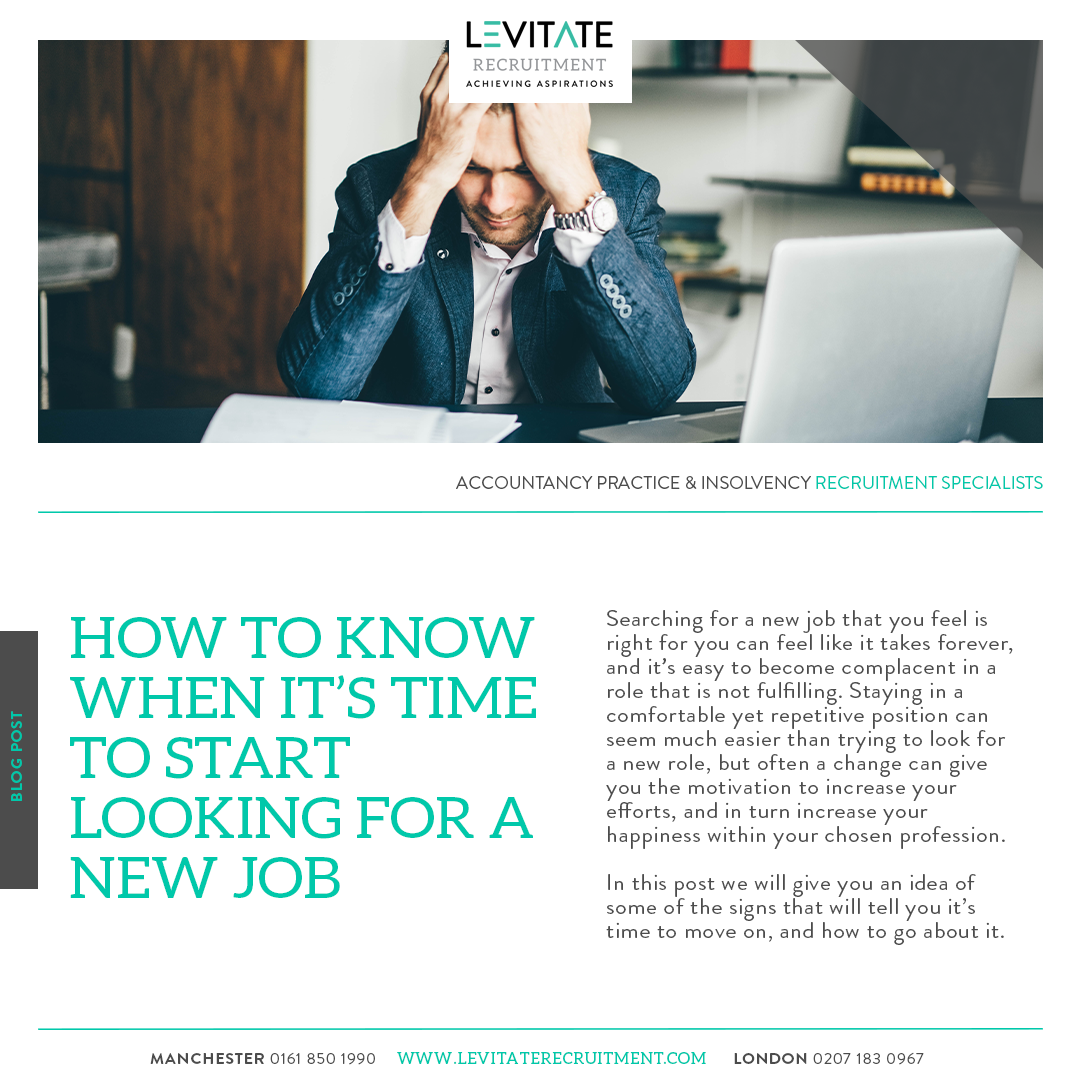
Searching for a new job that you feel is right for you can feel like it takes forever, and it’s easy to become complacent in a role that is not fulfilling. Staying in a comfortable yet repetitive position can seem much easier than trying to look for a new role, but often a change can give you the motivation to increase your efforts, and in turn, increase your happiness within your chosen profession. (Take a look at our Conquering the Fear of Change: Embracing New Job Opportunities post)

It can be incredibly refreshing to change to a new company and experience new practices and clients. If you are considering looking for Insolvency Jobs, Audit Jobs or Tax Jobs, then this post is intended to give you an idea of some of the signs that will tell you it’s time to move on, and how to go about it.

The Signs

No route for progression

This is a popular reason people tend to move on from a job, however, it is often overlooked when starting your career for the first time. As you develop your experience and progress within a firm you may reach a ceiling where future progression can become very difficult.

Lack of progression can be that there is no room to advance your position (promotions) or that the level of work will no longer differ from what you have already done, meaning that your professional development can stagnate (I will cover this point later).

The size and type of firm you work for can have an impact on what level of progression opportunities exist. Some examples include;

  • Firms can be ‘top heavy’ meaning that there are already several Senior Management level employees in positions which can result in there being no room for further positions at a Senior Management level.
  • Promotions are not meritocratic, meaning that career progression is not based on being the best person for the role at the time.
  • Those in the more senior management positions are ‘lifers’ within the firm. Meaning this individual is unlikely to ever leave the firm/position as they have everything they need from their career within their role. This can block your career progression.
  • In some smaller firms, there may be limited opportunities to progress purely due to the size of the team. For instance, there is no need for 2 managers to manage a team of 4 when one manager is enough.

You’ve reached a ceiling in your professional development

After you’ve been in a role for a significant amount of time it can be easy to slip into a routine of taking on the same clients and assignments. They can become easy and monotonous, but for some, this is their preference. However, if you’re looking to challenge yourself and want to progress in your chosen field, you won’t do this by undertaking the same work over and over again.

In order to find more complex and challenging work, you’ll inevitably have to move on to a different job. If this is your driving factor in finding a new job, then make sure you search intelligently. Look for opportunities that are going to stretch your abilities and establish what the role would involve longer term.

For some, the initial learning curve of a new job can often be the best bit.

Looking for a more challenging role might make your job search a little narrower, however, if you are looking to make move to better your career it’s important to find the right opportunity that can help you in achieving your short, medium- and long-term career aspirations.

The workplace culture doesn’t fit

The culture and office environment can differ greatly between firms and offices. This might seem like a trivial reason to look for a new job, but considering how much time we spend at work you should be able to enjoy the environment you work in.

Perhaps you’re a dynamic, outgoing type working in an old-fashioned firm that’s stuck in its ways. You may feel that your ideas are slightly more progressive than your current employer. It may be beneficial to join a more forward-thinking firm.

One of the best things about the accountancy and insolvency profession is that there is no shortage of firms, so it shouldn’t be hard to find one that suits your career outlook.

Work/Life balance (lack of it!)

When starting out in your career it can be quite common for employers to put lots of work on you. Additionally, if you’re still trying to gain experience in the industry, it can be tempting to take on extra hours or work overtime not just for the experience but to gain favour with your employer too. While giving extra can seem like the right thing to do, it can soon become expected of you.

When beginning your career, your life can be significantly different to where you are in 5 years.

Things change in our lives that may need us to redirect some of our attention elsewhere other than just work. You may have fallen in love, had a child, there may be an illness in your family or simply had a refocus of your life/career aspirations.

Finding a good balance between work and home life is necessary not just for our personal relationships, but for our mental health too. We need time away from the office to balance our thoughts and refresh our energy for work.

Having a fair work/life balance does not mean you are work shy.

Lack of study support

When starting a career within Accountancy Practice you will typically commence with an accountancy qualification immediately. In some cases where you may have started out with the AAT you may find that your firm is not able to put you through the ACA or ACCA straight after completing your AAT. Another issue may be that your firm only provides support for the ACCA when you want to undertake the ACA (or vice versa). The industry I typically find the biggest issue with lack of study support is Insolvency.

Studying for further qualifications can be a great way of increasing your salary and is sometimes required if you want to move up the career ladder. Some firms are happy to support further education on the basis that you continue working for them after gaining the new qualifications but will tie you in for a period of time post qualification.

If you’re thinking of gaining some more qualifications, whether this is to gain more experience in your current field or to switch to a different one, you may want to join a firm that has a track record of providing their staff with study support for further qualifications.

However, we often find that new employers will not immediately offer new employees study support as part of an offer so before making a move for future study ensure the role is also going to enhance your professional experience.

You are not being fairly rewarded

This is probably the most common reason I hear as to why someone wants to find a new job.

It is important to be paid fairly in your industry for your level of experience and the position you hold in comparison to your peers. It is worth noting that salaries from firm to firm can differ by a couple of thousand for the same position and a difference of £1k-£2k shouldn’t really be considered a deal-breaker. (Read our Easiest Way to Get a Pay Rise: ASK! post)

However, if you feel you are being significantly underpaid, then it may be wise to explore your options in the market. You may have had an annual pay increase every year for the last 4 years let’s say, however, if you are still paid £4k less than your peers in the industry then you are being severely undervalued.

I do consider this reason to be the biggest risk of them all for making a career move if it is purely down to salary. For example, you could earn less in the long run of your career if you make a move for an extra £3k+ now but the role does not offer you the chance to develop your experience.

Other things worth considering are your overall package and holiday entitlement. Benefits can differ greatly within the industry; some benefits packages can be worth as much as £5k in monetary terms. Additionally, some firms will have provided 20 days standard holidays whilst others as many as 27 days per annum.

Is it time to start looking?

The above are only a few of the signs that may make you think it is time to explore your career options. If you are unhappy or feel unfulfilled in your current role then it’s probably time to do something about it.

That being said, I advise you to take a step back to evaluate why you are unhappy or what the issue is (read our From Breakup to Makeup: Rekindling Your Relationship with Your Job post). The first port of call should be to assess whether it can be resolved without the need to move jobs. If it can, then resolve them. (Read our The Dangers of Starting Your Job Search Before Resolving Internal Issues post).

If not, establish what a role would need to be better than the one you are currently in. Once you understand your ideal role it will become easier to identify suitable opportunities in the market. (Read our Finding your perfect match: Targeting the Job That’s Right for You post).

The main thing to remember when searching for a new job is you should make sure this new role will be beneficial to your short, medium and long-term career and personal aspirations. You may be able to solve one of the issues outlined above by moving jobs but be careful not to sacrifice one of the others in doing so. For instance, it can be tempting to choose a job because it’s got a higher salary but if the level of work is a step backwards or you must work 12 hour days, you may find yourself looking for another role in the not-too-distant future.


Some of other posts that may help;


My views are based on my 17 years+ of recruiting for Insolvency and Accountancy Practice professionals.

For advice about your career options, Insolvency Jobs, Audit Jobs or Tax Jobs, speak to Scott Lowes at Levitate Recruitment, specialists in placing insolvency professionals and practice-trained accountants across the UK, and find the right role to suit your ambitions.
Competency Based Interview Questions – What are they and how to ace them

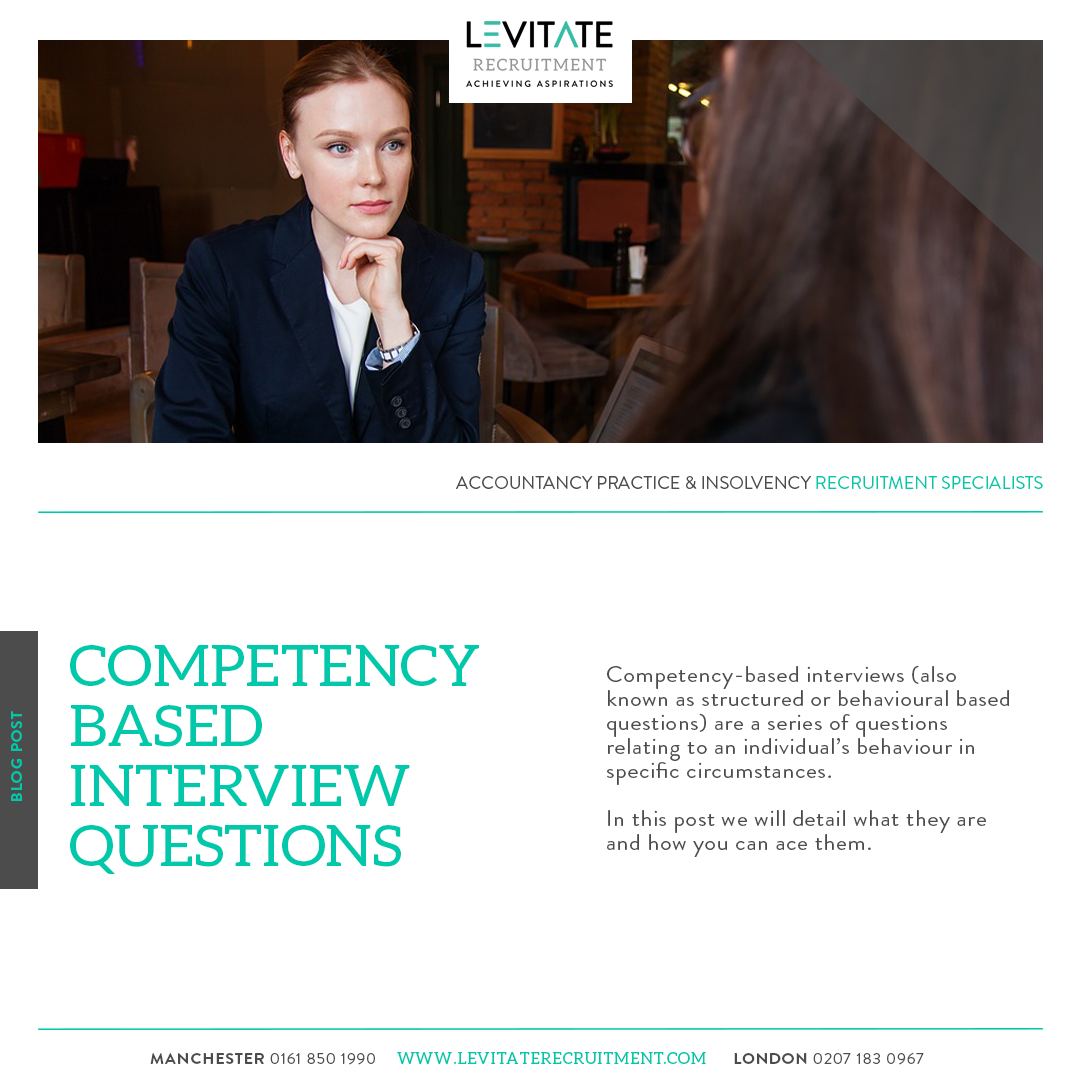
As a specialist Insolvency & Accountancy Practice recruiter, it is our job to consult candidates throughout their careers and during their insolvency, audit or tax job searching process which can be for many, a stressful time. There is a lot to consider in the early stages of a search to ensure we can identify together what is the best next step but further down the line and one of the key parts, is of course the interview stage as it is the first and potentially only opportunity for a candidate to sell themselves to the potential employer.

The general objective when interviewing someone for a specific role is to identify if that person has the right skills, experience, personality and attitude for the role they are applying for. Different firms and interviewers have different approaches of how best to discover if someone is the right candidate. Some will ask a few questions that are relevant to what they are looking for but without any specific aim in mind other than getting an overall impression of you as an individual. Most of these questions are generally quite ‘open questions’ and often will not test any specific skill or competency leaving the decision to determine if someone is right to be quite subjective.

Within this article, we are going to concentrate on what competency-based questions are, why they are used and how best to answer them during an interview. For some of the people reading this, it may not be anything new, but having prepared over 500 accountancy professionals throughout my career for interviews, we are confident that there will be many who have never faced a competency-based question and some who haven’t even heard of them or have no understanding what they are.

What is a Competency-Based Interview Question?

Competency-based interviews (also known as structured or behavioural-based questions) are a series of questions relating to an individual’s behaviour in specific circumstances. The interviewer will generally decide what they feel are the most important competencies required within the role and they will expect specific examples of how you have managed and dealt with situations you have faced previously either inside or outside of the workplace.

It use to be the case that competency-based questions were generally only utilised by HR recruiters in the larger Big 4 and Top 10 firms. This was mainly because their recruitment processes were more refined due to the number of staff they employ each year and to ensure they are identifying the best professionals in the market.   As time has progressed and Mid-Tier and smaller firms have developed their processes, we have noticed that they are becoming increasingly popular and something that candidates should be aware of when preparing for an interview

Whilst competency-based questions can be challenging and put you on the back foot if you haven’t prepared for them, they should be seen as a great opportunity for professionals to demonstrate their skills and accomplishments and ultimately, a great chance to show potential employees why you are the right person for the role.

Preparation

The majority of interviewers will ask you to provide specific examples of previous work or situations you have faced whilst others may throw specific scenarios at you and then expect you to follow up with previous examples or if you have none to offer, how would you approach the situation to reach your objective.

Prior to the interview, it is important for candidates to think about what competencies are important for the role they have applied for. These competencies can often be uncovered within a job specification in the key skills section but it is also important for you to think about what other skills they may wish to uncover and what skills you are keen to get across during the interview.

Typical Competencies

It can be difficult to prepare for every question that an interviewer may ask as each person will have their own style and technique. The same goes for guaranteeing the competencies they will explore but we have set out below some of the key ones to consider:

Accountability – They will be looking for evidence that you are self-motivated and take responsibility for the decisions you make and the tasks you need to manage. Typically, they will ask you to tell them about a recent time when you took personal responsibility for delivering a project or assignment.

Business focus – The challenge here is to demonstrate your ability to identify business opportunities and successfully manage commercial risks. They will usually ask you about some of your recent client work and look for evidence of how you have helped grow the relationship and identify new business opportunities.

Building relationships – Much of your work will be in teams, so they will be looking for evidence of how well you work with others. They will ask you about times you may have helped a colleague or recognised the need to change your style to get the best out of others.

Making an impact – Clients expect you to be a confident professional who is capable of making an impact and building strong business relationships. They will therefore be judging how strong an impact you make on them during the interview, and are likely to talk to you about times when you had to persuade a client to follow your advice or successfully negotiate a difficult issue.

Developing people – It is important as you progress your career as an accountant that you can support the development of colleagues. Sharing knowledge, giving constructive feedback and coaching or mentoring others are important people management skills. The questions here will focus on times when you might have supported the development of others or coached a colleague through a difficult problem.

Delivering quality service – It’s essential that you can deliver a high quality of service to clients (both internal and external). They might well ask you to describe a time where you have had to manage multiple tasks and they will need you to tell them about your ability to prioritise and delegate to make sure you deliver the service clients expect.

Problem-solving – They will question you about how you approach a problem and look for evidence of your ability to analyse complex data and reach an appropriate solution.

Professionalism – It goes without saying that acting with integrity and being professional at all times are business-critical requirements. The questions might ask you about a time when you received great client feedback for the quality of work you delivered.

Drive and Resilience – We’ve all faced times when we’ve had to overcome challenges or setbacks to achieve a goal. They will ask you about times when you’ve needed to overcome obstacles or worked under pressure with enthusiasm and a positive attitude.

Feedback and Learning – Most businesses encourage everyone to continuously learn from their experiences and seek out their own development opportunities. The questions here will focus on both your own recent learning experiences and how you’ve encouraged others to learn and develop.

Interpersonal Skills Having the ability to build rapport and relationships with colleagues and clients is a key part of most roles within accountancy. The questions will focus on how you have managed to do this across different levels and they may also focus on when you have struggled to do this and how you have overcome the issue.

Organisation – It is key for you to be organised as an accountant, especially one that works within practice where you are managing a range of different clients and working on multiple projects at any one time. These questions will not just focus on how you manage your own workload but also potential projects and how you may have acquired people and other resources to accomplish a goal.

How to answer a competency-based Interview Question

If you were to type ‘How to answer competency-based questions’ online then you will find 1000s of results from HR and recruitment professionals. Whilst, not every opinion is the same, you will find the majority will advise you to use the ‘STAR’ approach.

S.T.A.R stands for Situation, Task, Action and Result.

  • The ‘Situation and Task’ form the introduction: Here you will describe the situation and the task you were faced with, when did this happen, where were you at the time and who else was involved in the plan?
  • Action: How did you achieve what you needed to? What action did YOU take? Sometimes people focus on what the group did and this makes it difficult for the interviewer to extrapolate your involvement. Make sure you refer to your contribution with statements such as ‘I did this’
  • Result: What results did you achieve? What was the benefit of your involvement? What did you learn from the experience, what may you do differently next time?

By using this structure, you will be able to provide a comprehensive answer and demonstrate to the interview that you can take a considered approach to situations before finding a solution or reaching your objective.

Practice and rehearse your answers 

It is important that any question you answer in an interview is delivered in an articulate manner but it is also important with competency-based answers to ensure that they are detailed and structured in the right way. Try to think of a few examples you can give for each competency and practice them over and over to ensure your delivery is effective

How is the interviewer responding?

As you explain your examples, it is important that you can assess the interviewer’s body language and that you are generating a positive response. If this isn’t the case then be confident enough to ask if the interviewer would like any further examples.

If you are generally struggling to think of an example then make the interviewer aware that you may not have ever faced a certain scenario but if you were faced with a certain situation then explain what you would do so that they are aware you will be able to take action and you have the ability to manage a situation.

Working with Levitate

We appreciate that many of the professionals we work with are experienced in client meetings and can present themselves well. Whilst this is the case, searching for a new job and being interviewed to talk about yourself is a completely different scenario and can be for some, one of the most stressful situations they have faced. Not preparing properly can lead to a lack of confidence and the potential of not being offered the position or perhaps an offer but with a lower salary.

Everyone at Levitate Recruitment has been trained in Interview preparation and will work closely with the professionals we represent to ensure that they have thought about the questions that will be asked and how best they can demonstrate to the interviewer that they should be the preferred applicant and ultimately offered the job.

If you have any questions about the accountancy job market or interview techniques then we would welcome the opportunity to discuss your situation and provide educated advice to make your next step, a well thought out and success assured career move.

We have a number of other blogs posts that may help with your interview preparation;


My views are based on my 17 years+ of recruiting for Insolvency and Accountancy Practice professionals.

For advice about your career options, Insolvency Jobs, Audit Jobs or Tax Jobs, speak to Scott Lowes at Levitate Recruitment, specialists in placing insolvency professionals and practice-trained accountants across the UK, and find the right role to suit your ambitions.
 

Does size matter? How long should a CV be?

The first step in working with someone looking for a new insolvency job, audit job or insolvency job is to find out about their experience, what they are looking for in their next role and understand their longer-term career aspirations. Following this, I will then review their CV and offer advice as to how they could improve it.

Some already have a CV, some need to update one and for others it is their first time of writing a CV.  The one question I always get asked is, how long should their CV be.

Nine times out of ten I get told that they have heard that their CV shouldn’t be any longer than 2 pages. They have usually read this somewhere or have previously been told this.

If you do a quick internet search, you’ll be amazed how many articles/posts on CV writing advise of a 2-page limit.

I believe that this one bit of advice can be severely detrimental to an individual’s job search.

Can your CV be too long? Yes, it can, but I don’t believe that there is a set page limit which if your CV does not conform to you will not be selected for an interview.

Having recruited for Accountancy Practice and Insolvency professionals for over 17 years, I have received tens of thousands of CVs from those with no working experience through to those with over 30 years of professional experience.

It’s been my experience that some job seekers are actually doing themselves a massive disservice because they badly present their experience or omit relevant information that could potentially be the decision breaker as to whether they are invited for an interview or not.

I believe the misconception of having a CV no longer than 2 pages is partly to blame.

What is the purpose of your CV? 

  • The simplest objective of your CV is to secure you the opportunity to interview for the insolvency job, audit job or tax job you are applying for.
  • It’s an advert of who you are.
  • It’s your opportunity to demonstrate to the reader your career experience.
  • It’s also an opportunity to highlight that you are the right potential hire for them.

Why is it important to get your CV right?

For every job advert, I put out I receive over 20 applications per opportunity. This is also the case for companies who advertise their own roles.

Many applications will not be viable at all, some will instantly stand out as suitable whilst others will not best represent the applicant’s experience, potentially resulting in them missing out on the chance to interview.

With so many applications per role, it is important that you are putting your strongest advert (CV) forward.

How I believe the misguided 2-page limit impacts a CV negatively

Having reviewed thousands of CV’s over the years, I have seen candidates do the following to stick to the 2-page guideline;

  • Not including a personal statement. This is your chance to give the hiring manager a short synopsis of who you are and what you are looking for.
  • Not including enough information about their current/relevant roles. Your current role is one of the most important parts of your CV. Hiring managers after a quick scan of your CV will then study your current role in more detail as it is a significant indicator of your suitability for the role you have applied for. It is key to ensure that you list your most important responsibilities. There may be some role-specific responsivities that you feel are less important or obvious, you should still include these as a hiring manager may assume incorrectly that you don’t do certain things in your role if they are not listed. I’m by no means suggesting that you list ‘Making coffee on an ad hoc basis’ but you should cover the key elements of your role.
  • Leaving previous jobs off their CV. There is an argument that jobs that are not relevant to your current career or next role have little importance. However, I advise that you should include the dates, company and position for all the jobs you have had. You don’t need to add any further information under these roles as to your responsibilities, however, the dates of previous employment will show the reader your career timeline from start to present.
  • Not addressing unexplained gaps in the CV. It’s important to cover any employment gaps in your career history. You may have been travelling, taken a sabbatical, had an illness, had children or even cared for a relative. Unexplained gaps could give the impression to a hiring manager that you did nothing during that time period.
  • Changing the font to a ridiculously small size to condense the CV down. It is pointless investing your time writing your CV to put yourself across in the best possible way if it is difficult to read. I typically suggest a font size between 10-12 dependent upon the font.
  • Not listing software/I.T. skills. There are so many different software packages that are used by different companies. Highlighting the specific software you have experience with can set you apart from other applicants if you have listed a software package that the hiring company uses.
  • Not including work achievements. If you have received any special recognition, awards or have worked on a high-profile assignment then they are definitely worth highlighting to a potential employer.
  • Leaving off personal interests/hobbies. You are not going to be invited to interview based on what you like doing in your spare time, however, I’ve had clients comment on people not having any interests in their CV. They felt that they wanted to see some personality and get a feel for someone from their CV.

Forget the 2-page limit!

CV’s come in all shapes and sizes. Some people like to display the information in a paragraph/essay format and some use bullet points (which is what I recommend). In reality, there is no one size fits all format for CV’s.

I’ve assisted hundreds of professionals to write and amend 1-page CV’s through to 6-page CV’s. The one thing that they all have in common is that the information included has accurately portrayed their experience.

The length of a CV can be dependent upon different factors like the font, font size, formatting and content. The level of content will also differ greatly from someone with 12 months of experience to someone with 15 years.

So, what’s important?

  • The information in your CV needs to be relevant and accurately describe what you currently do and have done in previous related jobs.
  • It should be displayed in a way that makes it easy to read. This includes, how the information is broken down as well as the font size and type used.
  • You should highlight your relevant experience for the types of opportunities you are looking to move into.
  • Don’t be scared to add extra information if you feel it is relevant.

 Do not miss the opportunity to sell yourself.

If you are worried that your CV is too long.

  • Read through your CV and ask yourself if all the information is relevant.
  • Check whether you have duplicated any information.
  • Unless relevant to your current career/role you are applying for there is no need to list what you did in your roles before starting your professional career. Just list the dates, the company and your position.

To conclude; it doesn’t matter if your CV is more than 2-pages. Your CV can be as long as is necessary for you to portray your career experience and suitability for the opportunities you are looking for.

If you are thinking about your CV you must be considering your next role, here are some other posts that may help;


My views are based on my 17 years+ of recruiting for Insolvency and Accountancy Practice professionals.

For advice about your career options, Insolvency Jobs, Audit Jobs or Tax Jobs, speak to Scott Lowes at Levitate Recruitment, specialists in placing insolvency professionals and practice-trained accountants across the UK, and find the right role to suit your ambitions.
 

The ‘Weakness’ Question

I recently read a post that said the weakness question in an interview is not relevant. The premise of the article was that it is a pointless question and that it is none of the interviewer’s business to ask about someone’s weaknesses. The article even suggested that if you get asked this question in an interview you would be well within your rights to walk out of the meeting at that point.

In assisting a significant number of individuals preparing for interviews for insolvency jobs and speaking with hiring managers over the last 10 years, the weakness question is one that many interviewees are unsure of how to approach.

I believe that it is a blinkered view that the question is irrelevant, as it can be one of the most important questions you can answer.

What is the weakness question?

The weakness question, like “what are your strengths?” is an awareness-based question. If you can identify where your abilities are strong, equally you should be able to identify where they are not an awareness-based question.

Why do interviewers ask it?

Admittedly, there are interviewers that do ask the question just because they see it as a standard interview question.

However, the more astute interviewers ask it because they want to see how someone handles/answers being challenged on a weakness. They are not so much interested in the actual weakness itself but whether the individual is aware of their weakness and what they do/have done about it.

If you are aware of your weaknesses, what are you doing about improving it?

How someone answers this allows the interviewer to assess how the individual will handle criticism/feedback in the role. Those that have identified their weakness and don’t do anything to improve it or make excuses for it demonstrate a different mentality to those that have actively sought to improve their weakness.

Think about it another way

I have assisted hundreds of candidates over the years in preparing for interviews, and once we get to the weakness question circa 90% are unsure as to what they should say. Where they have had an answer almost immediately to all the other questions we have covered, they suddenly start to second guess what they should say.

Over the last couple of years, I’ve changed the way I ask the question from using the word weakness to asking if they have any areas or attributes they could improve.

It seems that people don’t like the word weakness and feel it is a personal attack on them. I noticed a significant difference when I changed the way I asked the question.

If we rank our strengths out of 10, you may rate them at 7, 8 or 9. So if we rank the areas that we need to improve, they may be anywhere from 1-6.

A weakness/area of improvement is never completely solved, all we can do is improve it and it is this that a potential new employer is looking for.

How to answer the question

Choose a weakness where you can demonstrate an improvement.

  • Explain what your weakness is.
  • Explain the negative effect it has.
  • Explain what you have done to improve it.
  • Explain how it has improved.

Tips

  • As with all potential interviews tips, be prepared.
  • Avoid a weakness that is a requirement for the role.
  • Avoid the stereotypical answers i.e. turn a weakness into a strength.
  • Avoid funny answers, i.e. Chocolate is your weakness.

I have never known for someone to be offered a job based on their answer to the weakness question. However, I have had a few experiences of instances where the way someone has responded to the question has cost them the opportunity.

We have a number of other blogs posts that may help with your interview preparation;


My views are based on my 17 years+ of recruiting for Insolvency and Accountancy Practice professionals.

For advice about your career options, Insolvency Jobs, Audit Jobs or Tax Jobs, speak to Scott Lowes at Levitate Recruitment, specialists in placing insolvency professionals and practice-trained accountants across the UK, and find the right role to suit your ambitions.
 

How to handle a telephone interview

Telephone interviews have always been a big part of the recruitment process for those looking to make an international move for insolvency jobs and audit jobs, however, we have seen an increase in the number of our clients in the UK requesting an initial telephone interview with prospective employees.  In a competitive insolvency jobs and audit jobs market, they see them as an opportunity to speed up the recruitment process. It is often quicker and easier to arrange a telephone call than it is to align diaries to meet face-to-face.

As well as fast-tracking the recruitment process it also allows the employer the opportunity to assess an individual’s viability for their opportunity before committing to a face-to-face interview. They are an easy way for companies to cut down the number of applicants.

The questions are usually more general than in a face-to-face interview and will be a chance for you to sell yourself. The key is to treat a telephone interview just like any other interview. Below are some suggestions to help you make the most of the opportunity.

Prepare!

One of the biggest advantages of a telephone interview is that you don’t have to be seen. This is particularly useful if you’re nervous because there won’t be any issues with body language.

It also means you can have notes prepared to give you a quick reference point. Write down a list of your skills and the answers to any potential questions you might be asked. However, be careful not to sound like you are reading or shuffling papers around.

Practice your telephone manner

We all speak on the phone quite a lot, whether this is in a professional setting or not. However, that doesn’t necessarily mean we have a good telephone manner. If you have concerns about the way you conduct yourself on the phone, practice with a friend in advance so you can nail the professional phone voice. Alternatively, record yourself speaking and listen for any issues of clarity or pronunciation.

Where you sit for the interview can make a massive difference. It can be tempting to slouch on the sofa, but this has an effect on your breathing, which in turn affects your speech. Sit at a table or desk with your back straight, and speak with a calm, clear voice. If you think you have issues with your pace, speak slower than you think is acceptable. It’s all too common to speed up when you’re nervous.

A tip I was given a long time ago was to smile whilst talking on the phone to clients and candidates. When you smile whilst talking your voice can sound warmer and friendlier.

Be professional

As much in the same way as dressing appropriately for a face-to-face interview, you should ensure that you are all set up and ready for the incoming call.

This might only be the first stage, but showing your professionalism now is a good way to stand out from the crowd. It almost goes without saying, but make sure there are no distracting noises (TV, pets etc) in the background, and that you have a good signal on your phone.

In conclusion

Listen carefully to their questions, and don’t be afraid to ask them to repeat something if you missed it. Make sure you don’t become too casual while talking and keep your answers short and sweet. It can be all too easy to forget who you’re talking to during a telephone interview. If appropriate, take notes during the call so you can be ready to ask any questions at the end.

At Levitate Recruitment, we think every stage is important, and so we’ve provided these tips to help you excel. As always, research the company and be prepared with any information that might be relevant. It’s always better to have too much than too little.

We have a number of other blogs posts that may help with your interview preparation;


My views are based on my 17 years+ of recruiting for Insolvency and Accountancy Practice professionals.

For advice about your career options, Insolvency Jobs, Audit Jobs or Tax Jobs, speak to Scott Lowes at Levitate Recruitment, specialists in placing insolvency professionals and practice-trained accountants across the UK, and find the right role to suit your ambitions.

Tips on handing in your notice

You’ve been interviewing for insolvency jobs, audit jobs, or tax jobs and now secured a new role. It’s time to hand your notice in.

Handing in your notice can be both a great and awful experience. Whether you’re moving on to your dream job or you’ve just had enough of your current role, it can be easy to use your notice period as a time to not adhere to rules and to tell them what you really think. However, it’s always best to remain professional.

Here are a few tips to help you when handing in your notice.

Write a resignation letter

A resignation letter is one of the few documents you should still deliver by hand, rather than email, and this is for a number of reasons.

Firstly, it’s always best to make sure it’s been received, and it gives you a chance to discuss things further with your boss.

There’s no need to go into too much detail in a resignation letter. In fact, you need little more than to notify them that you intend to leave the business state your notice period.

It’s not necessary to state why you’re leaving, but feel free to include this information if you wish – just keep it professional.

It’s always worth including a thank you for the opportunities they’ve given you, even if you didn’t enjoy the job. After all, you might need a reference from them in the future.

Choose the right time

Picking the right time to hand in your notice makes all the difference to the reaction. Try to avoid busy or stressful periods, as you don’t want an over-negative reaction to your news. Try to pick a quiet time of the week that will give you plenty of chance to discuss the matter in detail. The more respectful you are in dealing with the situation, the better the reaction is likely to be.

Prepare what you’re going to say

Knowing what to say when resigning can be difficult, especially if you have a good relationship with your employer. It’s worth practicing in advance or writing down the main points you wish to discuss. Whatever you choose to say, keep your emotions in check and remain professional. If your boss chooses to take your resignation badly, the worst thing you can do is rise to it.

If your reasons for leaving the company are negative, then choose your words very carefully. It’s not unreasonable for a boss to react badly to negative feedback about their company or management style. Consider phrases such as “the role just isn’t for me” or “I think it’s time I explored opportunities elsewhere.” If they ask for more information don’t feel obligated to give it. After all, you’re the one in control of this situation.

Be aware

This is often the time when your employer will tell you that they can resolve all your concerns, increase your salary or offer you the ‘world’ so you will stay.

Remember, you are handing your notice in as you have already gone through the decision-making process to find a new job. You have met with new companies and established that you can advance your career elsewhere.

Don’t let your employer’s reactive response to you leaving stop you from progressing your career. We have seen it time and time again, that those who decide to stay based on promises made when handing their notice in are typically looking to leave again within 6 months.

The main thing to remember when handing in your notice is always to remain professional. It’s much better to leave a job with your head held high than to voice your true feelings. Leaving a good last impression makes all the difference and will work in your favour in the long run.

Some of our other blog posts around this subject may help;


My views are based on my 17 years+ of recruiting for Insolvency and Accountancy Practice professionals.

For advice about your career options, Insolvency Jobs, Audit Jobs or Tax Jobs, speak to Scott Lowes at Levitate Recruitment, specialists in placing insolvency professionals and practice-trained accountants across the UK, and find the right role to suit your ambitions.

 

    Contact///